
While recovery efforts are ongoing, the likelihood of recovery currently appears low.

India is set to take its first steps towards its own human space flight when the uncrewed Gaganyaan mission soars to the skies later this year. Private players in the space sector are also gearing up for launching satellites on home-built rockets.

'Why not aspire for 8 or 9 or even 10 per cent?'

The satellite, weighing about 4,410 kg will be the heaviest to be launched from the Indian soil and into a Geosynchronous Transfer Orbit (GTO), the space agency said. The satellite will travel onboard a LVM3-M5 rocket, dubbed as 'Bahubali' for its heavylift capability.
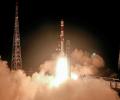
The Indian government has approved the construction of a third launch pad at Sriharikota, capable of sending heavier spacecraft into orbit. This new facility will support India's ambitious space program, including the Gaganyaan human spaceflight mission and a lunar landing. The launch pad will be built at the Satish Dhawan Space Centre and is expected to be operational within four years.

The Indian Space Research Organisation (ISRO) successfully launched its third and final developmental flight of Small Satellite Launch Vehicle here on Friday whose payloads can be used in applications like satellite-based surveillance, disaster and environmental monitoring, fire detection, volcanic activity among others.

Around 23 minutes after lift-off, the primary satellite got separated and it was followed by six other co-passenger satellites, which were deployed into the intended orbits sequentially, ISRO said.
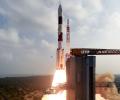
The Indian Space Research Organisation (ISRO) is all set to make its maiden commercial launch of 36 broadband communication satellites on board the space agency's heaviest rocket LVM3-M2, the countdown for which began early on Saturday at Sriharikota spaceport in Andhra Pradesh.

The Bharatiya Antariksh Station represents the next phase of India's human spaceflight ambitions, enabling long-duration presence in space, advanced microgravity research and technology development, and supporting future human exploration missions.
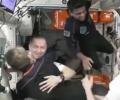
India's Group Captain Shubhanshu Shukla and three other astronauts on Thursday reached the International Space Station as the Dragon spacecraft docked with the orbital laboratory.

ISRO is set to launch its communication satellite CMS-03 from Sriharikota. The satellite, weighing 4,410 kg, will be the heaviest launched from Indian soil into a Geosynchronous Transfer Orbit (GTO).
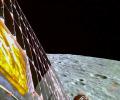
According to the Indian Situational Space Awareness Report for 2023, the nominal lift-off of the Launch Vehicle Mark-3, carrying the Chandrayaan-3 spacecraft, had to be delayed by four seconds based on the Collision on Launch Avoidance analysis.

ISRO chairman S Somanath said the success gave the space agency "greater confidence," as the GSLV will be next deployed in the NISAR mission, a collaborative effort with the US' NASA.

From a surge in startups to crewed mission preparations, 2025 marks a transformative year as India eyes $44 billion space economy by 2033.

The company said this would boost their efforts to send tourists to space by 2009 and help quick point-to-point travel across the earth using a space vehicle.

NASA astronaut Sunita Williams retires after 27 years, completing three missions aboard the International Space Station and setting numerous spaceflight records. She is currently visiting India.
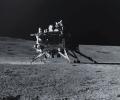
The cryogenic upper stage of the LVM3 M4 launch vehicle, which successfully injected the Chandrayaan-3 spacecraft into the intended orbit on July 14 this year, made an uncontrolled re-entry into the Earth's atmosphere, the ISRO said.

The three astronaut crew were carried to China's Tiangong space station and will replace a similar crew that have been in space for the last six months.
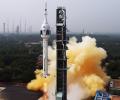
Chandrayaan-4 will involve at least two separate launches of the heavylift LVM-3 rocket that will carry five different components of the mission which will be assembled in orbit.
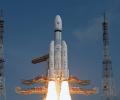
The test vehicle development flight (TV-D1) will be conducted at the Satish Dhawan Space Centre in Sriharikota in Andhra Pradesh to test the crew module that is scheduled to house Indian astronauts during the human spaceflight late next year.

After the historic success of its Chandrayaan-3 lunar mission, Indian Space Research Organisation (ISRO) is going full throttle with its plans to send Indian astronauts for the first time to the Moon by 2040, ISRO Chairman S Somanath said.
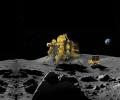
In a boost to the space programme, the government on Wednesday approved the Chandrayaan-4 mission to bring back moon rocks to earth, to send a spacecraft to orbit planet Venus and to expand the Gaganyaan project to build an Indian space station.

In terms of success rate, the PSLV rocket has an enviable record of 57 successful missions out of 58 commercial ones.

The Reliance Industries' digital services company Jio Platforms Limited has signed an agreement with SpaceX to offer Starlink's broadband internet services to its customers in India, the company said on Wednesday. The agreement is subject to SpaceX receiving authorisation to sell Starlink in India. The development came a day after Jio's rival Bharti Airtel signed a similar pact with SpaceX.

The new year will witness two unmanned missions under the "Gaganyaan" project, deep ocean exploration project, "Samudrayaan" and many more.
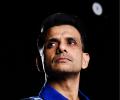
Indian astronaut Shubhanshu Shukla will be the first Indian to travel to the International Space Station (ISS), flying aboard a SpaceX Dragon spacecraft as part of a joint effort between NASA and ISRO. Shukla, a group captain in the Indian Air Force, will serve as the pilot for the Axiom Mission 4, scheduled for launch no earlier than spring 2025. The mission will also carry the first astronauts from Poland and Hungary to stay aboard the ISS.

The Indian Space Research Organisation (ISRO) on Monday successfully launched its maiden X-Ray Polarimeter Satellite that would offer several insights into celestial objects like black holes.

Six planets -- Mercury, Venus, Mars, Jupiter, Saturn, and Uranus -- will appear together in the evening sky.

'Techfest', an annual science and technology event organised by the Indian Institute of Technology Bombay in Mumbai.
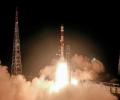
State-run Hindustan Aeronautics Limited has won a bid under which it will receive technology from the Indian Space Research Organisation for the end-to-end commercial production of the Small Satellite Launch Vehicle (SSLV), a first for the industry as India seeks to become a global hub for small satellite manufacturing and launches.
China may launch the country's first space laboratory module at the end of this week with hectic last minute preparations in full swing.

If Rakesh Sharma represented the dreams of a nascent India looking outward, Shubhanshu Shukla embodies a confident India reaching for the controls.

According to ISRO officials, Earth bound orbit is a phase during which the spacecraft will remain in the Earth's sphere of influence.
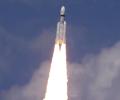
For the Gaganyaan programme, LVM3 rocket is re-configured to meet the human rating requirements and has been christened as 'Human Rated LVM3', ISRO said and it would be capable of launching the Orbital Module to an Low Earth Orbit of 400kms.

A satellite placed in the halo orbit around the first Lagrangian point (L1) of the Sun-Earth system has the major advantage of continuously viewing the Sun without any occultation/eclipses, the IIA said.

The heaviest rocket of the Indian Space Research Organisation -- LVM3-M2/OneWeb India-1 -- blasted off from the Sriharikota spaceport on Sunday to place 36 broadband communication satellites into the Low Earth Orbit (LEO) for a UK-based customer.

The mission was originally scheduled for lift-off on May 29 but was put off multiple times when engineers detected a liquid oxygen leak in the boosters of the Falcon-9 rocket and NASA also detected leaks in the ageing Russian module of the ISS.
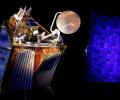
On Sunday, at 12.07 am in Sriharikota, off the coast of the Bay of Bengal, it was almost like an early Diwali, with the sky lit up by the launch of 36 OneWeb satellites. The Indian Space Research Organisation (Isro) did the launch on a 43.5-metre-tall Geosynchronous Satellite Launch Vehicle Mark III (GSLV Mk III) rocket. After the countdown, which started 24 hours in advance, once the mega screen marked the launch, a select group of invitees at the gallery cheered by applauding the feat.
The company had announced similar pricing for Sri Lanka, where its application was in advanced stages of regulatory clearance.
Currently, some of the rocket hardware for the human space programme has reached the Satish Dhawan Space Centre in Sriharikota and the integration of the crew module was going on at the Vikram Sarabhai Space Centre, Trivandrum, ISRO chairman S Somanath said.
